Should You Put a Photo on Your Resume? (US vs International Rules)

Introduction
Should you put a photo on your resume? In the United States, Canada, the UK, Ireland, and Australia, the short answer is usually no. Applicant tracking systems can mishandle images, and many recruiters remove photos to reduce bias risk. But in parts of Europe and Asia, a resume picture is still customary and sometimes expected.
So the real answer depends on where you are applying, not on personal taste. This guide gives you a country-by-country decision table, explains the risks behind the US convention, and shows where a professional photo actually helps your job search. You will leave knowing exactly when to include a resume photo and when to keep it off the page.
If you already have a polished headshot ready, you can still use it well. It just belongs on your LinkedIn profile, email signature, or portfolio far more often than on the resume itself.
Quick Answer by Country
The convention shifts sharply across borders. Use this table as a starting point, then confirm the norm for your specific industry and employer before you submit.
| Region / Country | Photo on Resume? | Why |
|---|---|---|
| United States | No | ATS issues and anti-discrimination practice |
| Canada | No | Bias-reduction norms; photo not expected |
| United Kingdom / Ireland | No | Equality-focused hiring conventions |
| Australia / New Zealand | No | Photo seen as unnecessary |
| Germany / Austria / Switzerland | Often yes | Traditional Lebenslauf still includes one |
| France / Spain / Italy | Commonly yes | Photo widely accepted, though optional |
| China / Japan / South Korea | Usually yes | Standard CV formats include a photo |
| Middle East / parts of LATAM | Often yes | Photo frequently expected |
When in doubt in a no-photo market, leave it off. You rarely lose an interview for skipping a resume picture, but you can be screened out for including one.
Why the US and Similar Markets Say No

In North America and much of the English-speaking world, a photo on your resume can quietly work against you. There are two main reasons, and both matter for your application.
Discrimination and bias risk
US employers actively avoid collecting information that could suggest race, age, gender, or national origin before a hiring decision. Federal law prohibits discrimination on these protected characteristics, so many companies strip photos to keep their process defensible (U.S. Equal Employment Opportunity Commission). A photo introduces exactly the data they are trying to ignore, and some recruiters discard photo resumes on sight to protect the company.
Applicant tracking systems
Most mid-size and large employers filter resumes through applicant tracking software before a human reads them. Images, text boxes, and heavy formatting can be parsed incorrectly, which garbles your work history or drops sections entirely. A clean, text-based layout is far more reliable, and career centers routinely recommend removing graphics that ATS tools cannot read.
Who should avoid a resume photo
If you are applying to jobs in the US, Canada, UK, Ireland, Australia, or New Zealand, skip the photo unless a listing explicitly requests one. This is especially true for corporate, tech, finance, healthcare, government, and any role processed through an ATS. The photo adds risk and no measurable benefit.
Where a Resume Photo Is Customary
In several countries, leaving the photo off can make your CV look incomplete. The expectation is cultural, not a sign of vanity, so match the local norm rather than importing US habits.
German-speaking countries
Germany, Austria, and Switzerland have a long tradition of the Lebenslauf, which often includes a professional photo in the top corner. While anti-discrimination law technically makes it optional, many applicants still include one because reviewers expect a complete, formal document. A crisp, neutral business portrait is the safe standard here.
France, Spain, Italy, and much of continental Europe
A resume picture is common and generally accepted across southern and central Europe. The Europass CV format even includes an optional photo field, which signals how normalized the practice is. It is rarely mandatory, but it will not hurt you.
China, Japan, South Korea, and parts of Asia
Standardized CV and resume templates in much of East Asia include a dedicated photo box, and many employers expect a formal headshot. In these markets, a missing photo can read as an incomplete submission rather than a modern choice.
What the photo should look like
Where photos are expected, keep them conservative: neutral background, business attire, natural expression, and a straight, well-lit face. This is the same standard that makes a strong LinkedIn headshot work, so one good portrait can serve both needs.
Create Professional Headshots in Minutes
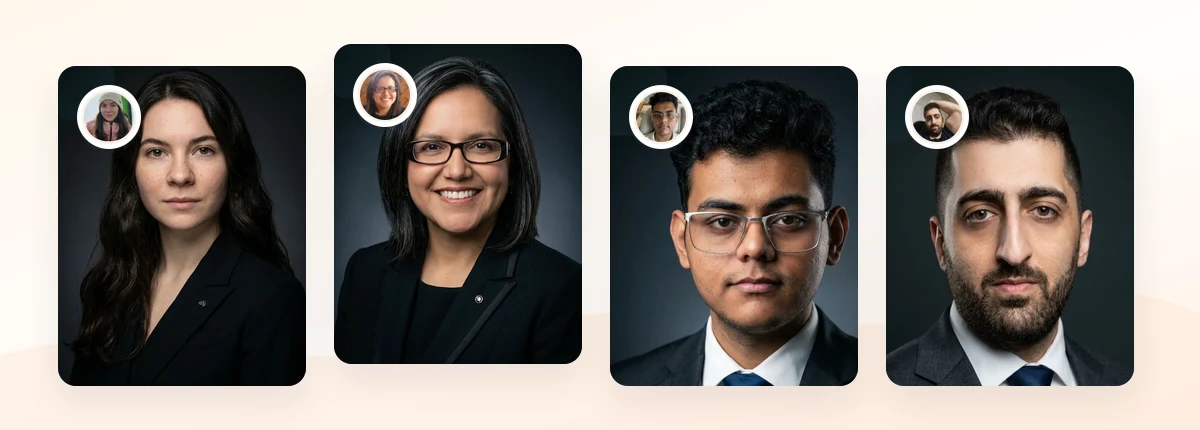
Upload 5-20 everyday photos and get 40-100 polished AI headshots for LinkedIn, resumes, company pages, and executive bios.
15-30 minute delivery • Full commercial rights • One-time payment
Get My Headshots →Where a Professional Photo Actually Belongs

Even if your resume should stay text-only, your professional photo still does important work elsewhere. The goal is to place it where it builds trust without triggering ATS problems or bias concerns.
The best home for a professional headshot is your LinkedIn headshot, which recruiters routinely check after reviewing a resume. LinkedIn profiles with a photo receive far more engagement, and the platform encourages a clear, recent picture (LinkedIn Help). That is where your face works for you, not against you.
Other strong placements include:
- Email signature: a small, consistent headshot personalizes outreach and follow-ups.
- Personal portfolio or website: an About page benefits from a friendly, professional face.
- Speaker bios and conference profiles: a photo is expected and adds credibility.
- Company directory and team pages: once hired, a consistent portrait keeps the roster cohesive.
In every one of these cases, the photo lives outside the ATS pipeline, so formatting risk disappears. You get the credibility of a strong headshot without the downsides of putting it on the resume document itself.
How to Decide for Your Situation
Use these decision rules to settle the question quickly for any application.
- Include a photo if you are applying in Germany, Austria, Switzerland, much of continental Europe, or East Asia, and the local format expects one.
- Include a photo if the job posting or application portal explicitly asks for one, regardless of country.
- Skip the photo for any US, Canadian, UK, Irish, or Australian role, especially when an ATS is involved.
- Skip the photo for creative roles too, unless it is a modeling or acting submission where the image is the product. In those cases you need a dedicated resume photo and headshot guide approach, not a corporate portrait.
- When unsure, default to no photo on the resume and put your best headshot on LinkedIn instead.
The tradeoff is simple. A photo can make your application feel personal and complete in cultures that expect it, but in bias-aware, ATS-driven markets it adds risk with no upside. Match the local norm, and route your face to the channels where it clearly helps.
Our Recommendation
For most readers applying in the US and similar markets, keep your resume text-only and let a polished headshot do its work on LinkedIn, your email signature, and your portfolio. This gives you a clean, ATS-safe document plus a credible professional presence wherever hiring managers look next.
If you are applying in a photo-expecting country, include a conservative business portrait that matches the local format. Either way, you only need one high-quality headshot to cover every use case, so invest in a photo that looks natural, current, and professional. A strong image works for your resume abroad, your profile online, and your outreach everywhere.
Create Professional Headshots in Minutes
Upload 5-20 everyday photos and get 40-100 polished AI headshots for LinkedIn, resumes, company pages, and executive bios.
15-30 minute delivery • Full commercial rights • One-time payment
Get My Headshots →Final Thoughts
Deciding whether you should put a photo on your resume comes down to location and format, not personal preference. In the US, Canada, UK, and Australia, a resume picture usually adds bias and ATS risk with no benefit, so leave it off. In Germany, France, and much of Asia, a professional photo is customary and often expected.
Wherever you land, your headshot is still valuable. Place it on LinkedIn, your email signature, and your portfolio, and use it on the resume only where the local convention calls for one. Start with one clean, current, professional photo, choose the channels that fit your market, and let the CTA below help you create it.
Frequently Asked Questions
Common questions about resume photos, ATS behavior, and where your headshot belongs.